


Trading Journal
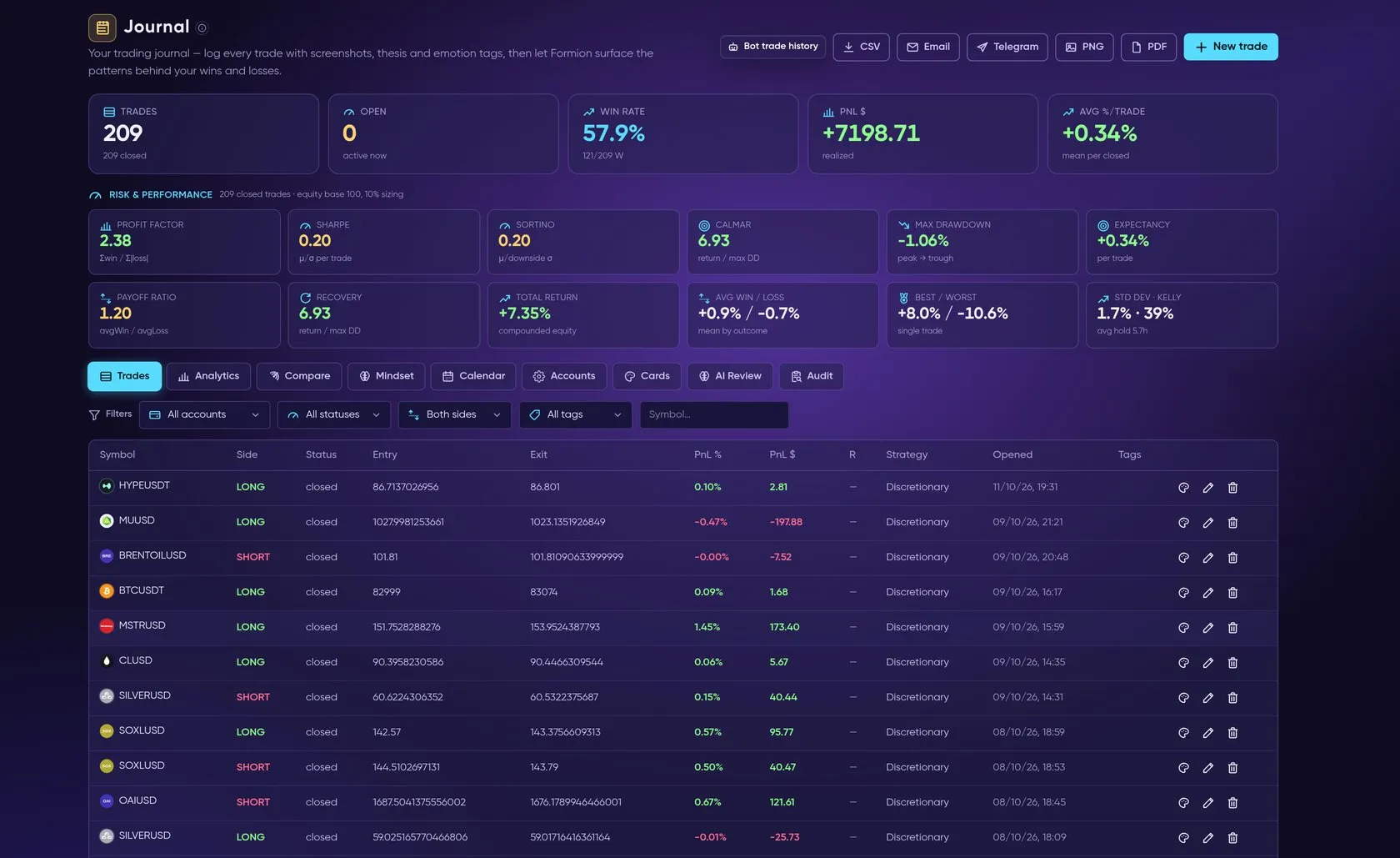
Journal → Trades: KPIs, risk & performance tiles and every closed trade.
The Journal is your own record of trades — from connected exchanges, webhook pushes and manual entries — with full performance analytics.
From import to audit in 16 seconds: connect an exchange → analytics → P&L calendar → Trading Audit (demo values).
Live recording on the demo account (two DEMO trades already logged): a new ETH trade entered by hand with the date picker — P&L $ is calculated from entry, exit, quantity and fee — then the KPIs, Risk & performance, Analytics and the daily P&L Calendar.
What it does
Section titled “What it does”- Log trades — manual entry with setup, tags, emotion, mistakes, rating, notes and screenshots.
- Exchange import — connect an exchange account with a read-only API key (
 Bybit,
 Binance,
 OKX,
 Gate,
 MEXC,
 Bitget,
 KuCoin or
 Coinbase). Closed trades are imported with Sync now and kept up to date by a background auto-sync.
- Webhook push — create a DEX-wallet or generic webhook account and paste its URL into a
 TradingView alert or your own bot to push filled trades in.
- Analytics — P/L, win rate, equity curve, risk metrics, MAE/MFE, and breakdowns by symbol, side and session, plus Compare, Mindset (tags and emotions) and a P/L Calendar.
- AI Review — an on-demand AI review of your edge, leaks and behaviour.
- Export & share — CSV download, or send the CSV to your email or
 Telegram; shareable trade cards.
Analytics
Section titled “Analytics”The Analytics tab turns your history into charts — no setup needed.
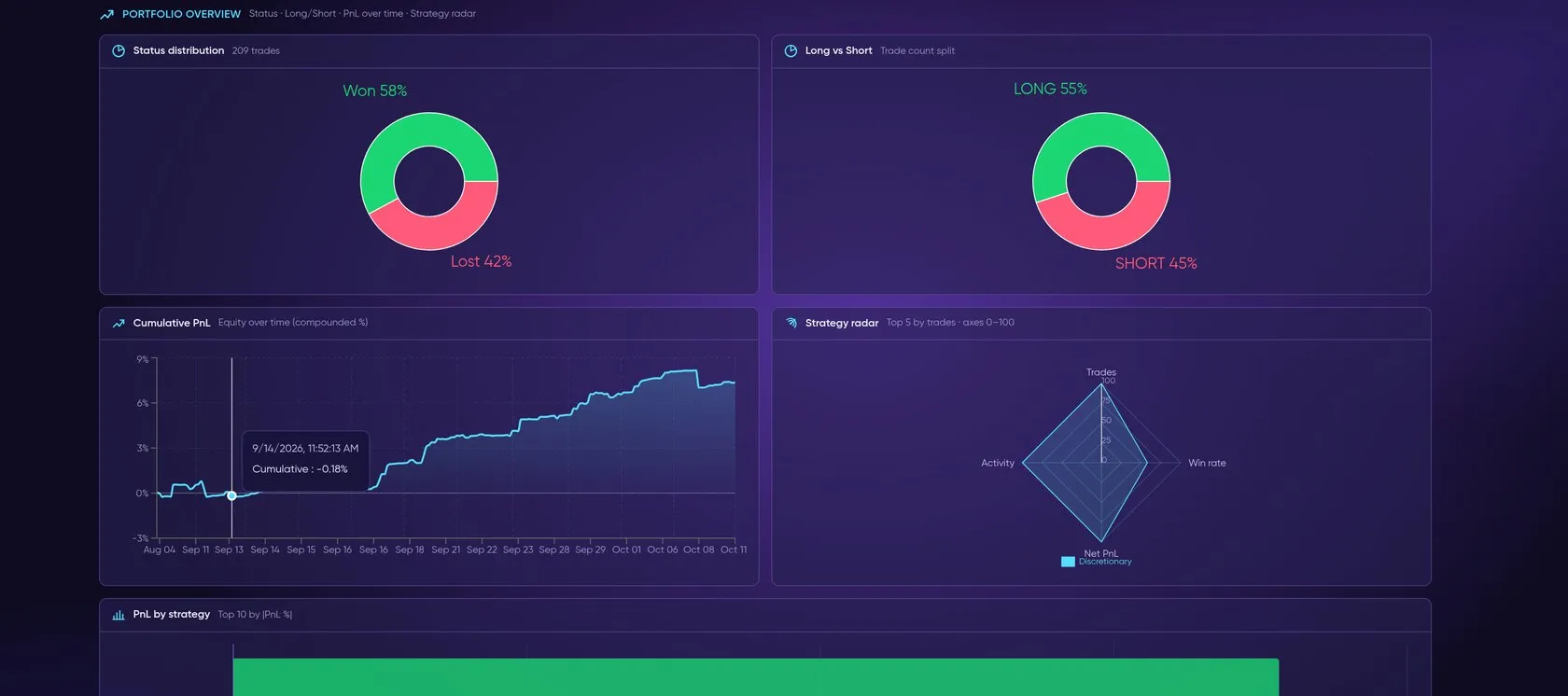
Status and long/short split, cumulative P&L and a strategy radar.
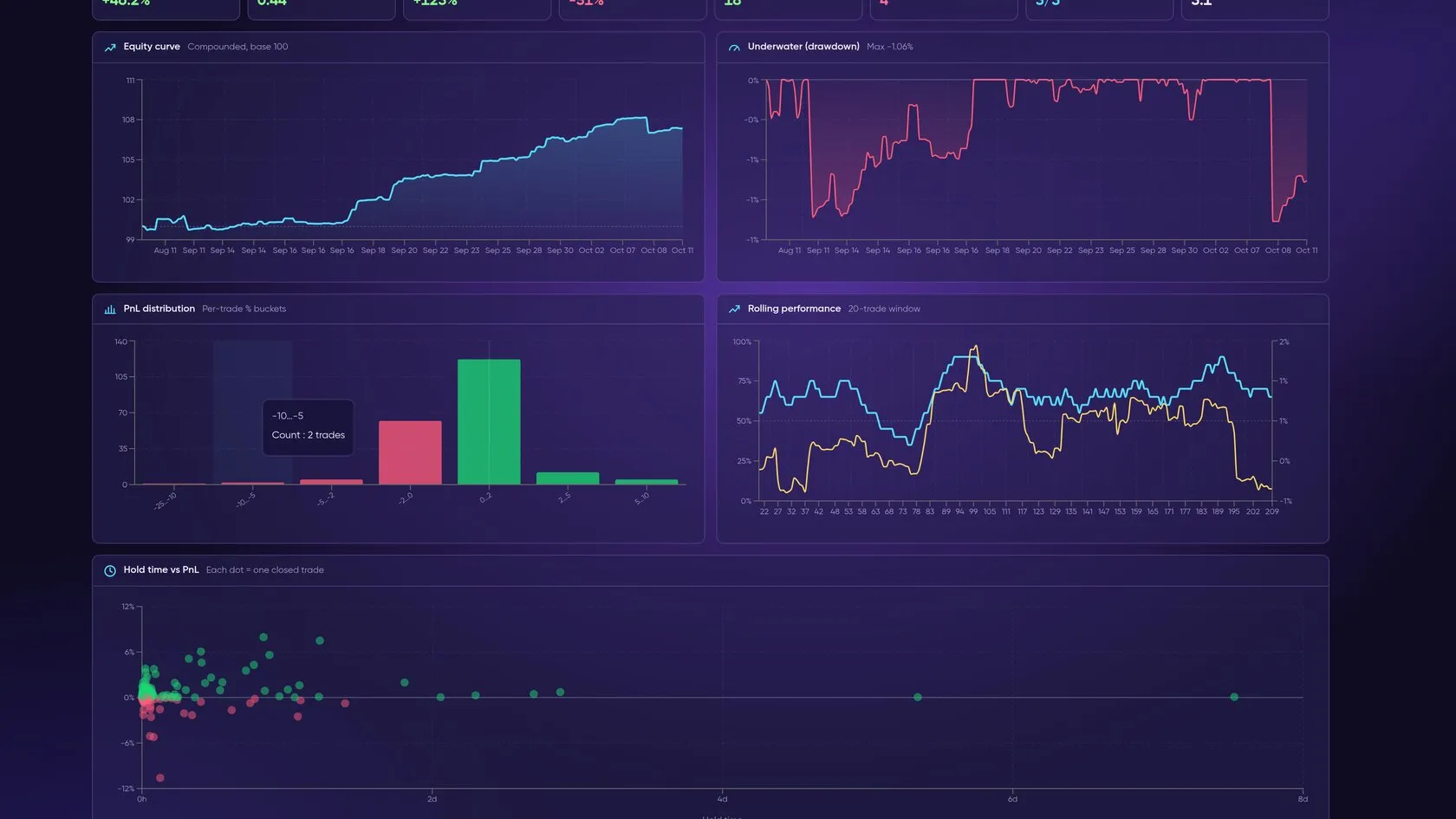
Equity curve, underwater drawdown, P&L distribution and rolling performance.
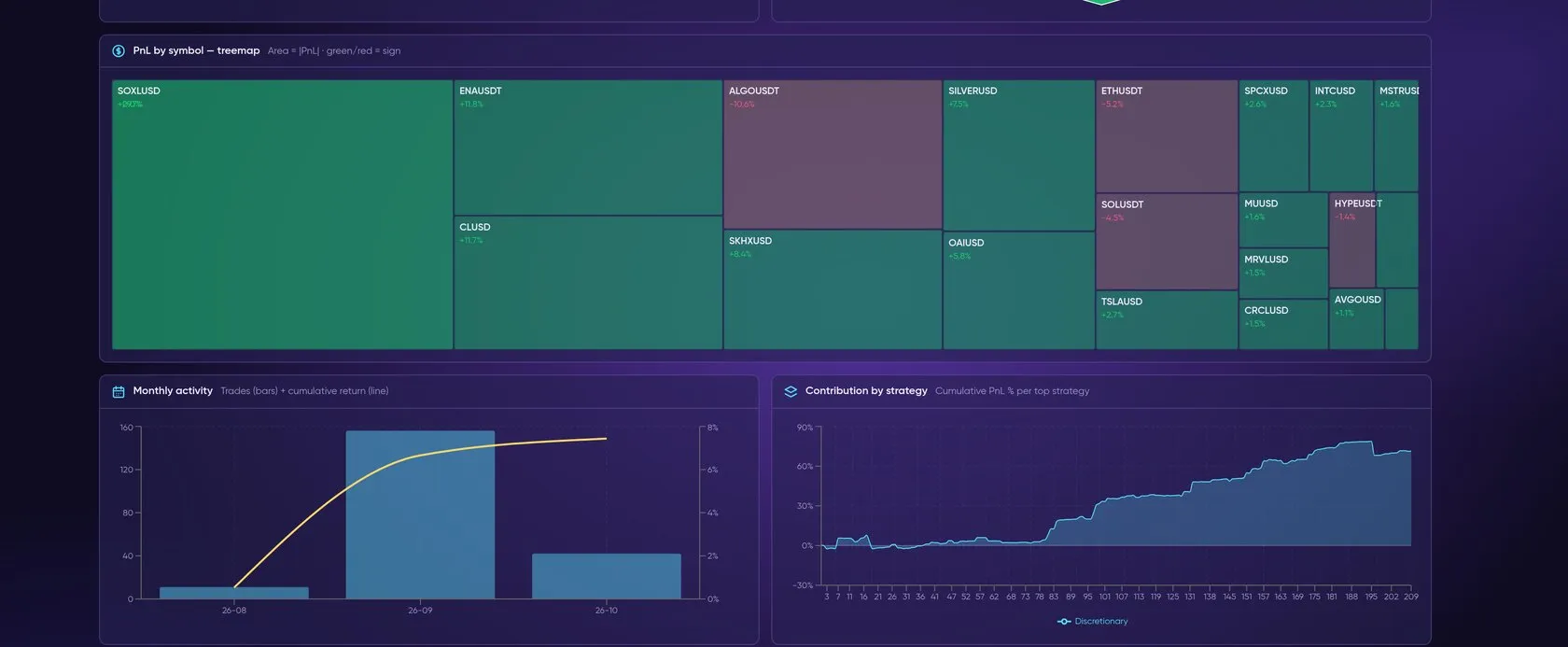
P&L by symbol as a treemap — green made money, red lost it — plus monthly activity.
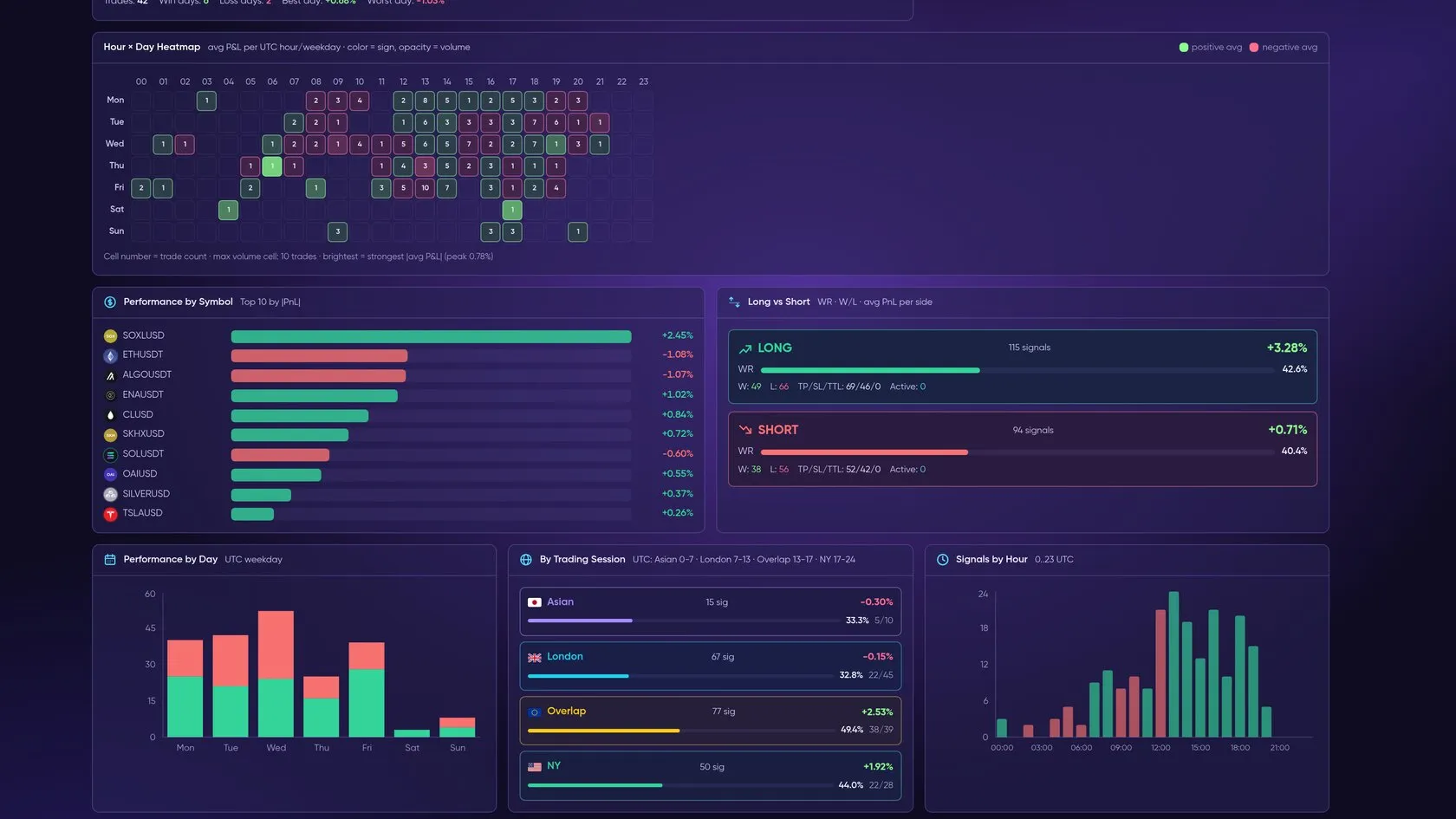
Hour × day heatmap, performance by symbol, long vs short, day of week and session.
Calendar and Compare
Section titled “Calendar and Compare”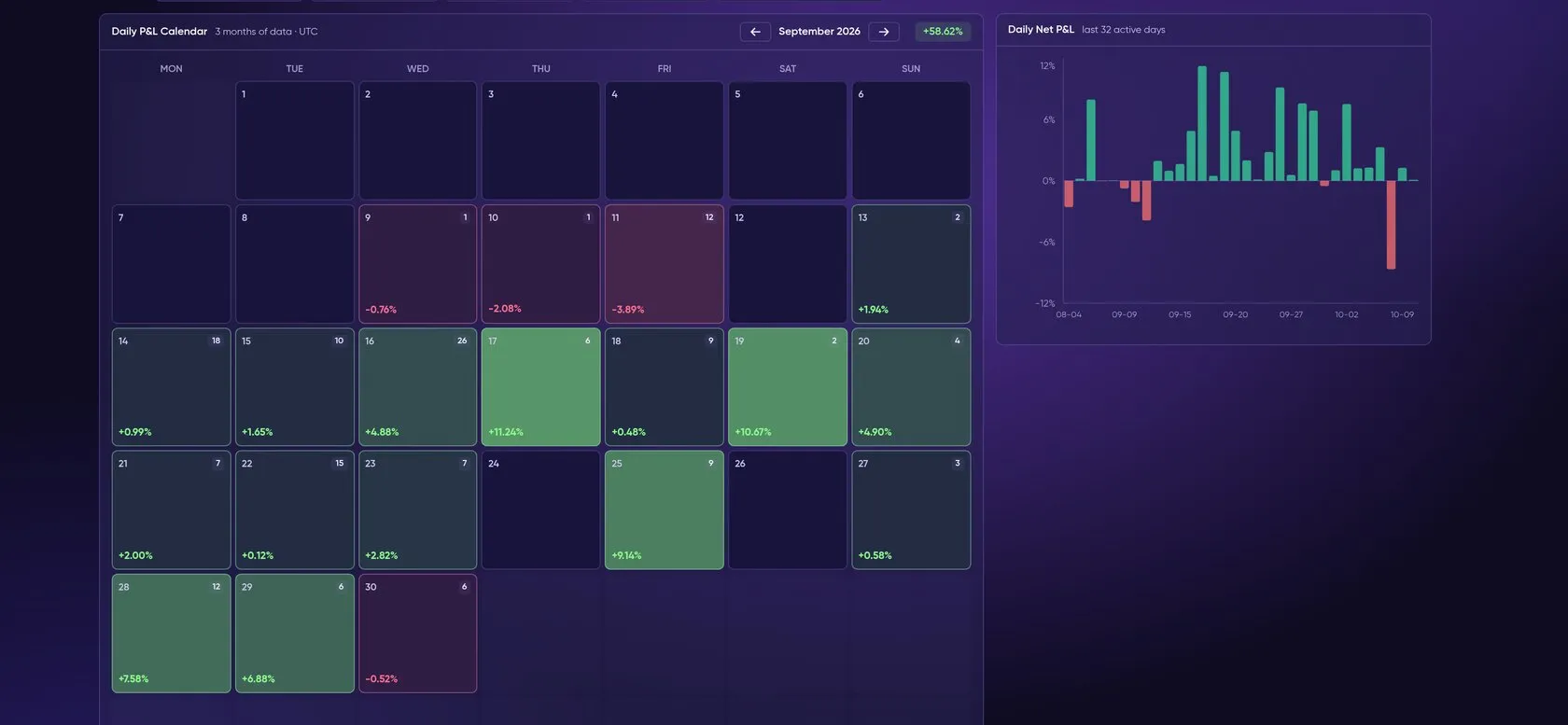
The P&L Calendar — each day coloured by its net result, with daily net P&L bars.
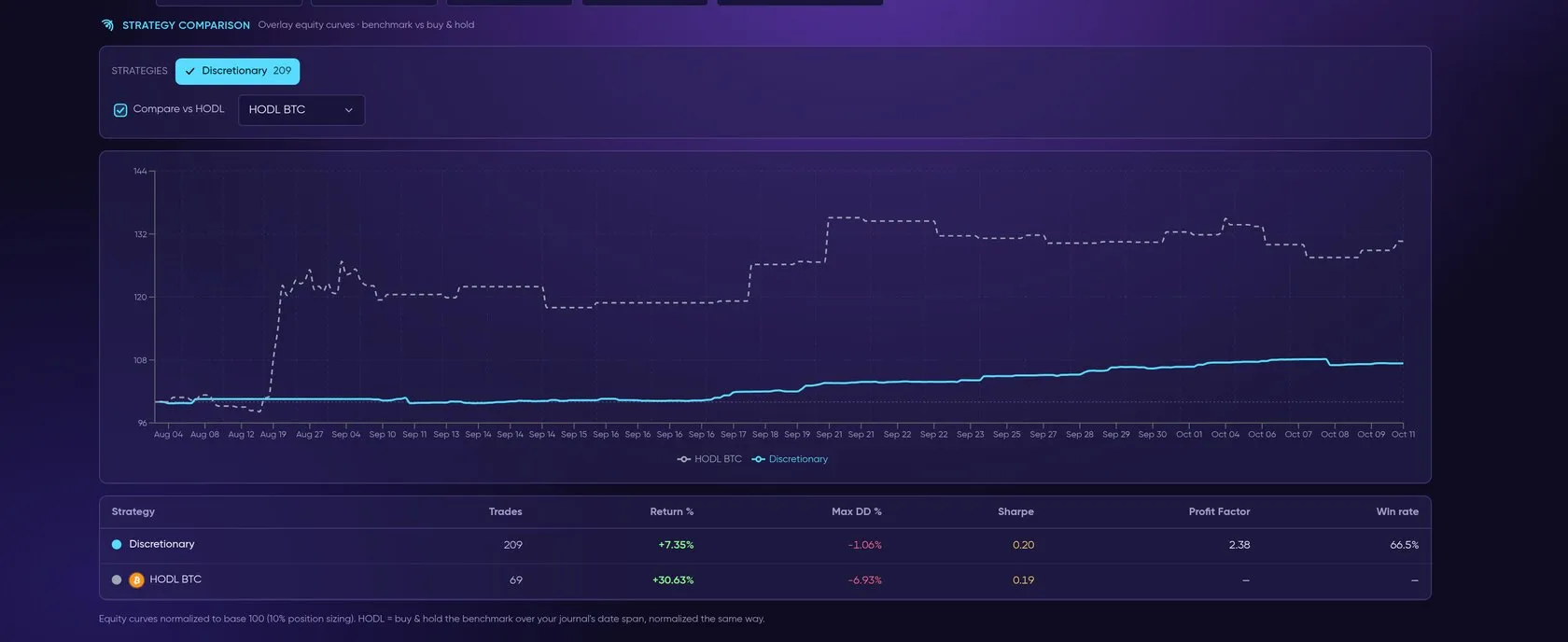
Compare: your equity curve against buy-and-hold BTC, with return, max drawdown, Sharpe, profit factor and win rate.
P&L cards
Section titled “P&L cards”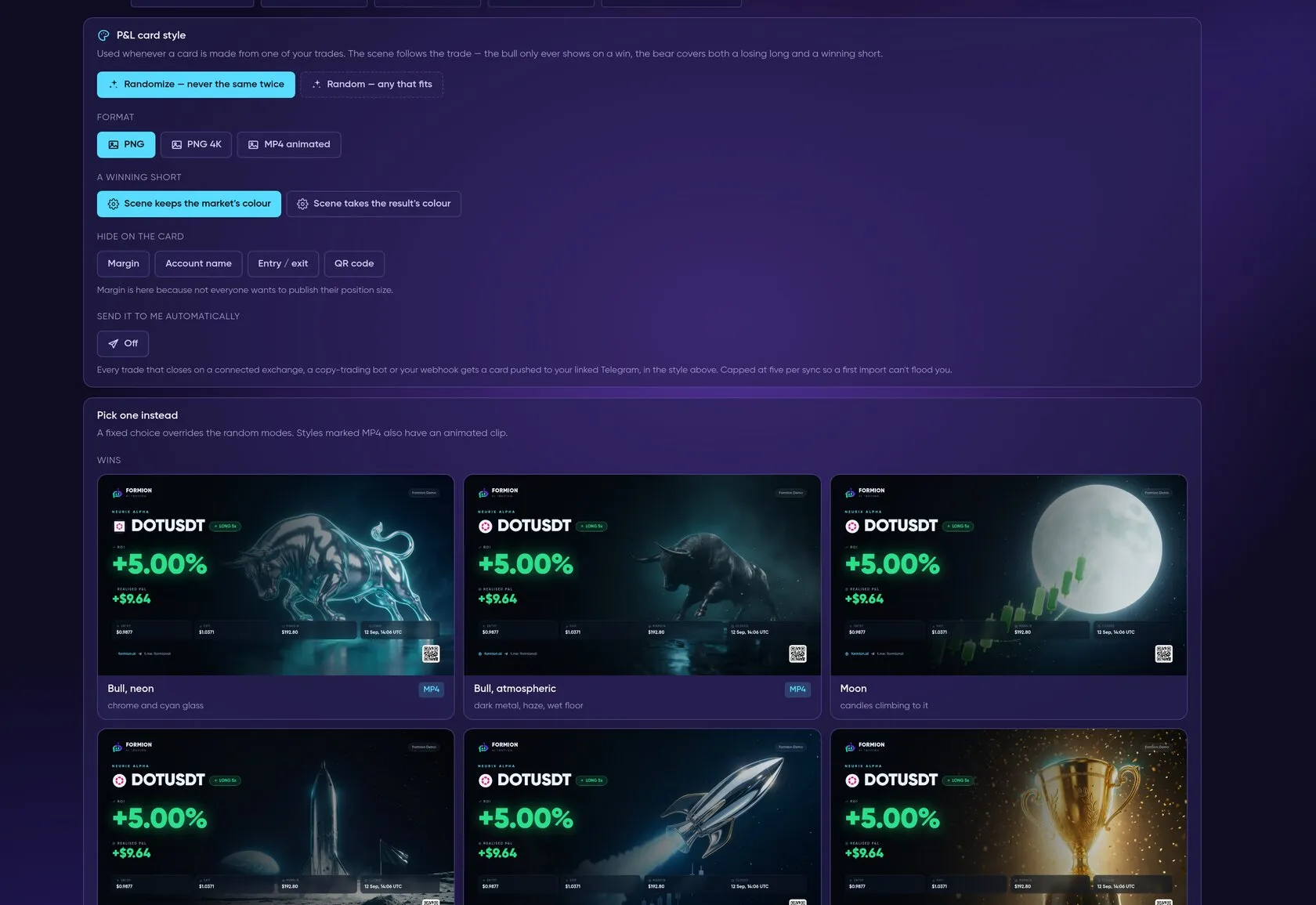
Shareable P&L cards: pick a style, choose what the card shows, then send it or post it.
Accounts
Section titled “Accounts”
Accounts: a manual account for hand-logged trades plus any connected exchange, DEX wallet or webhook.
By plan
Section titled “By plan”| Neural (Free) | Pro | Institutional | |
|---|---|---|---|
| Journal history | 30 days | Unlimited | Unlimited |
| Image uploads | 10 | Unlimited | Unlimited |
| Exchange auto-import | — |
Open it from app.formion.ai → Journal.
Trading Audit
Section titled “Trading Audit”Trading Audit checks your own closed trades phase by phase: profile, edge with a 95% confidence interval, leaks confirmed on a holdout, behaviour, stop and exit quality, follow-up (demo values).
Trading Audit reviews your own closed trades and tells you, with statistics rather than opinions, where your edge is and where money leaks. Open it at Journal → Audit (short link app.formion.ai/audit) or send /audit to @formiontradingbot. Pick one Journal account or all of them.
What the audit checks:
- Profile — what, when and how you trade.
- Edge — your expectancy with a 95% confidence interval, so a lucky streak isn’t mistaken for skill.
- Leaks — setups, symbols, sessions or sides that cost you money, confirmed on a chronological holdout (trades the detector didn’t see).
- Behaviour — revenge trading, tilt, size creep, overtrading, holding losers / cutting winners, and tail risk.
- Stop & exit quality — measured on real minute candles: were stops too tight, did exits leave money on the table? Alternative exits are judged only on unseen trades.
- Follow-up — adopt a recommendation as a rule and the next audit checks whether you kept it; an optional weekly audit arrives on Telegram.
Audit allowance: Neural — 1 basic audit in total; Pro trial — 3 audits for the whole 7-day trial; Pro — 3 per day; Institutional — 10 per day. Findings are only reported when they pass strict significance tests, so a short history may produce few findings — that is deliberate.
Journal and tracked strategies
Section titled “Journal and tracked strategies”The Journal reviews your own trading decisions. Trades History separately consolidates Formion’s tracked strategy and signal outcomes; check whether a source represents paper tracking or live fills.